

In today's space of contemporary visual art, Cedrick Dela Paz emerges as a distinctive voice, whose work primarily engages with the themes of social realism and the cultural implications of societal issues. His artistic practice showcases a style rooted in figurative expressionism, where he carefully distorts traditional representations of the human form while remaining anchored in recognizable figures. This technique underscores the individuality of his subjects and the depth of their narratives. Dela Paz's work often confronts the viewer with the stark realities of Filipino life, engaging them in a dialogue about the complexities of societal pressures and cultural identity.
Dela Paz's approach to figuration is unconventional; he deliberately distorts human figures to emphasize their emotional and psychological depth. He utilizes acrylics predominantly and employs multi-panel or polyptych formats, which not only enhances the dramatic impact of his subjects but also facilitates a more nuanced storytelling mechanism. His art is deeply rooted in the cultural and social contexts of the Philippines, echoing the struggles and triumphs faced by individuals against the backdrop of broader societal challenges. Dela Paz's work invites viewers to contemplate the narratives he presents, as he often portrays figures in states of vulnerability or conflict, thus evoking empathy and a heightened awareness of the human condition.
In interviews, Dela Paz has articulated his motivation to reflect the somber realities of life in the Philippines. Regarding his artistic philosophy, he mentioned, "Art should be a mirror of society; it should provoke thoughts and discussions about who we are as a people." This perspective is evident in his works, where he draws on personal and collective experiences to create pieces that resonate on multiple levels—personal, cultural, and societal. He has expressed that he aims to ensure that the viewer engages not only with the aesthetics but also with the underlying messages of his paintings.
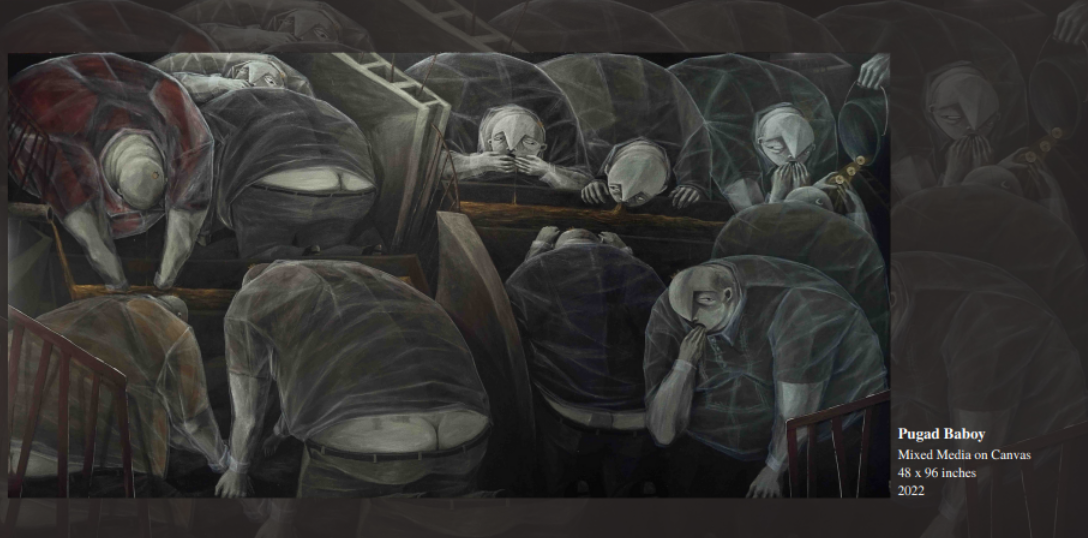
Analyzing specific works, one can appreciate how Dela Paz utilizes color and form to convey emotional weight. The 2 artworks under consideration are in the "Tangkal: Pugad Baboy," showcased in Dela Paz's fourth solo exhibition, which draws inspiration from the artist's past experiences in Pasig, specifically a space known as "Pugad Baboy."
The Pugad Baboy artwork stands out not only for its materials but also for its conceptual depth, presenting a striking visual metaphor for societal hierarchies and injustices. Measuring an impressive 48 by 96 inches, the piece occupies significant physical space, reflecting the weightiness of its themes. The visual distortion resonates with the viewer on an emotional level, making the figures almost grotesque yet deeply human, evoking a sense of empathy.
Dela Paz, C. (2022). Pugad Baboy. Art Cube Philippines. https://www.artcubephilippines.com/_files/ugd/5d812e_e4d32f2e75cb46eb838c74e6612664b2.pdf
In this artwork, the viewer is confronted by a chaotic assembly of figures, each representing various societal elements. The distortion of anatomy not only serves to capture emotional states but also critiques the socio-political landscape. Through expressive brushwork and unconventional figurism, Dela Paz articulates the "hogs" of society—representative of corrupt officials and the powerful elite—who are characterized as grotesque entities feeding off the marginalized. This imagery compels viewers to reflect on the political realities of power dynamics and economic disparity. The work engages with the concept of social realism, highlighting the conflicts between privilege and poverty, a recurring theme in Dela Paz's oeuvre.
Furthermore, the Pugad Baboy reveals how Dela Paz utilizes color, form, and texture to accentuate the narrative present in the artwork. The color palette comprises somber tones that echo the melancholy and disillusionment of the subject matter. The rawness of the acrylic medium adds an element of immediacy and urgency, heightening the viewer's emotional response. Dela Paz's choice of a polyptych format adds layers to the story, enabling multiple interpretations and inviting the viewer to traverse through the narratives of each figure. The figures' positions and gestures communicate a profound sense of imbalance, mirroring the societal tensions that persist in Philippine society. This analysis unveils Dela Paz's mastery of visual language, as he transforms acrylic paint into a medium that resonates with palpable human truths.
Interpreting it requires an understanding of Dela Paz's intent and the contextual backdrop against which the artwork is situated. The title itself, "Pugad Baboy," speaks volumes, as it references both a physical location significant to Dela Paz's childhood and the broader societal implications associated with the term. The theme captures not only personal nostalgia but also serves as a critical commentary on societal decay and moral bankruptcy. Dela Paz's references to political figures as "hogs" shed light on the artist's stance against the exploitation of the poor and underprivileged. This interpretative layer adds depth, situating the artwork within the discourse of social justice and the urgency for change.
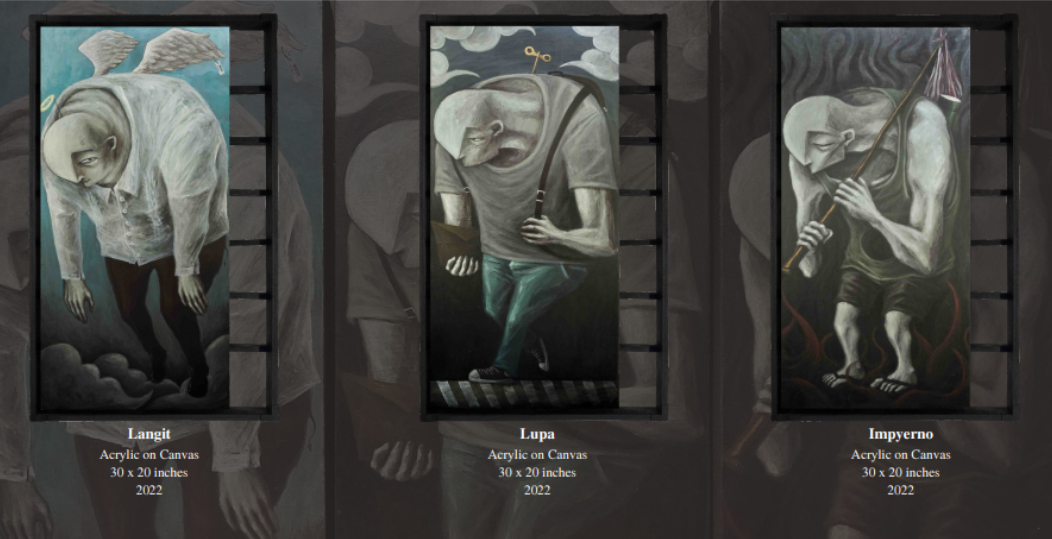
Moving to the next artwork, "Langit, Lupa, Impyerno" draws a similar structured elements as with the previous artwork. In "Langit, Lupa, Impyerno," Dela Paz again employs his distinctive style to convey powerful messages about societal issues, yet he takes a different approach in terms of composition and thematic focus. This artwork depicts a series of figures characterized by their thin, sunken-eyed appearances, symbolizing the marginalized and impoverished members of society. Dela Paz's figures here evoke an acute sense of sadness and despair, which profoundly resonates with viewers who are aware of the socio-political dynamics at play.
 Dela Paz, C. (2022). Langit, Lupa, Impyerno. Art Cube Philippines. https://www.artcubephilippines.com/_files/ugd/5d812e_e4d32f2e75cb46eb838c74e6612664b2.pdf
The work's visual elements are strikingly potent. The figures, despite being dressed in traditional garments like the barong (Langit), cannot escape the grim realities of their existence that Dela Paz portrays with raw honesty. The contrast between their appearances and the notion of pride associated with cultural attire underscores the dissonance between societal expectations and the stark reality of poverty. This critique of social status is a poignant observation that prompts viewers to reflect on the everyday lives of those hidden beneath societal layers. The choice of color in the artwork tends to be muted, reinforcing the somber theme while allowing the figures' expressions to take center stage. In the structure, one can observe how Dela Paz arranges the figures in a way that emphasizes their plight. The downward posture of the subjects signifies defeat and despair, while their fixation on the ground reinforces a metaphorical connection to their societal status—grounded beneath those in power. This analysis of form and posture successfully conveys the psychological weight of the figures, further engaging the viewer in the emotional landscape painted by Dela Paz.
In relevance, Both "Pugad Baboy" and "Langit, Lupa, Impyerno" exemplify Dela Paz's commitment to portraying the human condition through a lens that is both intensely personal and socially aware. The emotional weight carried by his figures, alongside the intricacies of their rendering, provides a potent critique of societal structures. His ability to blend personal narrative with broader societal issues is a testament to his skill as an artist and his insight as a cultural commentator. Dela Paz's works resonate on multiple levels, engaging viewers to confront uncomfortable truths about social injustices and their implications on individual and collective identities. In a time where art serves as a vehicle for social change, Dela Paz's poignant visual narratives enrich the dialogue around socio-political circumstances, encouraging reflection and, ultimately, action.
As for his career, Dela Paz has received accolades such as the Special Citation from the Metrobank Art and Design Excellence in 2019, which speaks to the impact of his work in the local art scene. His involvement with various art competitions further reflects his commitment to refining his craft while addressing significant societal issues through art. As a member of the artist collective, Door 305, he continues to collaborate and contribute to discussions on contemporary art in the Philippines.
In essence, Cedrick Dela Paz's art serves as a powerful commentary on Filipino culture and society. His unique ability to marry figurative representation with profound social critiques not only enriches the contemporary art landscape but also provokes essential conversations about identity, resilience, and the human experience. His work is both a reflection and a challenge, prompting viewers to engage deeply with the complex realities portrayed within each piece. As he continues to develop his practice, it will be intriguing to witness how Dela Paz further explores the intersections of art, society, and personal narrative in his future works, continuing to inspire dialogue and reflection among audiences.
Contributor | Kisiebel Tojong
REFERENCES:
Dela Paz, C. (n.d.). Cedrick Dela Paz. Eskinita Art Gallery. Retrieved from,
https://www.eskinitaartgallery.com/cedrick-dela-paz
Rito, J. (2023, January 18). Cedrick Dela Paz's 'unconventional figurism' at Leon Gallery
International. The Philippine Star. https://www.philstar.com/lifestyle/2023/01/18/2238249/cedrick-dela-pazs-unconventional-figurism-leon-gallery-international
Dela Paz, C. (2022). Pugad Baboy - Cedrick Dela Paz. Art Cube Philippines. Retrieved from,
https://www.artcubephilippines.com/exhibit-2022/pugad-baboy
Dela Paz, C. (2022, August 13). Cedrick Dela Paz's fourth solo exhibit - Pugad Baboy. BluPrint.
Paz Showcases His New Works in Fourth Exhibit ..., https://www.pinterest.com/pin/pugad-baboy-cedrick-dela-pazs-fourth-solo-exhibit-bluprint--338825571980462025/
